Ask. It Builds.
Natural language in, autonomous execution out. GPT-5.5 Pro on Yesmind handles the rest.
What is GPT-5.5 Pro?
GPT-5.5 Pro is OpenAI’s most capable language model to date — a <span class="hl-pill">ground-up rebuild</span> of the GPT architecture, not an incremental patch. Codenamed “Spud” internally, it represents the first fully retrained base model since GPT-4.5. The result is a <span class="hl-pill">frontier AI model</span> that doesn’t just respond to instructions — it plans, reasons, and executes multi-step tasks the way a skilled engineer would approach a complex project.
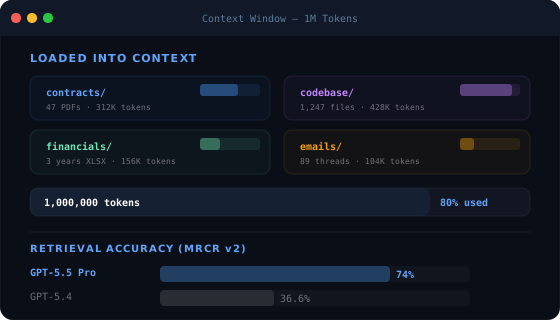
Where previous models required careful prompt engineering to stay on track, GPT-5.5 Pro introduces <span class="hl-pill">long-horizon problem solving</span> as a native capability. Its 1 million token context window isn’t just a headline number — MRCR v2 retrieval at 512K–1M tokens hits 74%, compared to 36.6% for GPT-5.4. Entire codebases, legal document suites, and research corpora fit inside a single conversation without losing coherence.
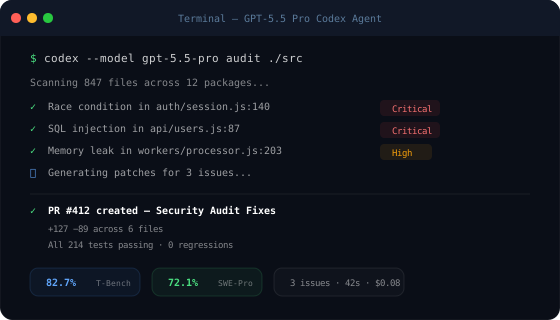
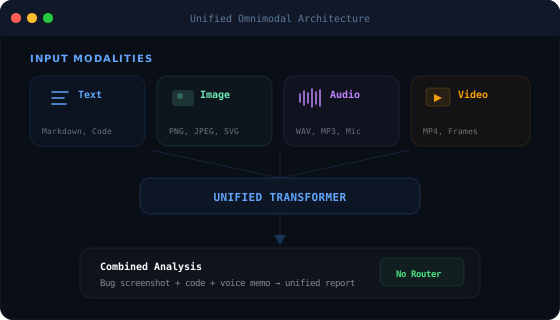
The model is also <span class="hl-pill">natively omnimodal</span>: text, images, audio, and video share a unified architecture with no modality-switching overhead. Pair that with 82.7% on <span class="hl-pill">Terminal-Bench 2.0</span> — a 13-point lead over Claude Opus 4.7 — and you have the first model that genuinely earns the label of autonomous AI agent for real production workloads.
Agentic Coding
82.7% on Terminal-Bench 2.0 — a 13-point lead over Claude Opus 4.7. Autonomous shell navigation, tool orchestration, and multi-file codebase manipulation. Not an assistant — an autonomous engineer.
1M Token Context
1M tokens with 74% MRCR v2 retrieval accuracy — 2× GPT-5.4, 2.3× Claude Opus 4.7. Feed it an entire repo, a year of filings, or a full case file. It reads, retains, and reasons across it all.
Natively Omnimodal
Text, images, audio, video — one unified architecture. No modality router, no conversion loss. Screenshot + code, video + transcript, PDF + chart + voice memo in a single request.
Computer Use
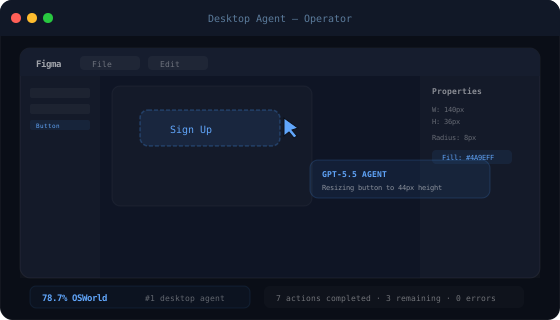
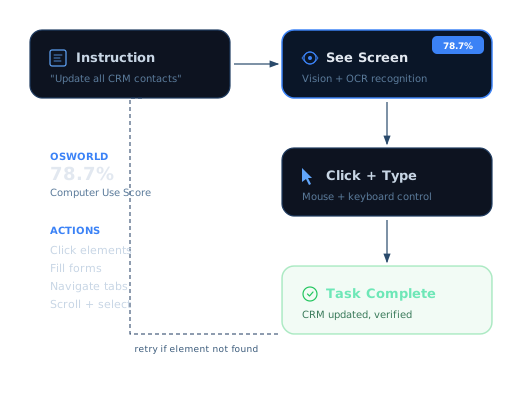
78.7% on OSWorld — real desktop automation. Navigate GUIs, fill forms, operate applications, execute multi-step workflows. Computer use goes from demo to deployable.
Web Research
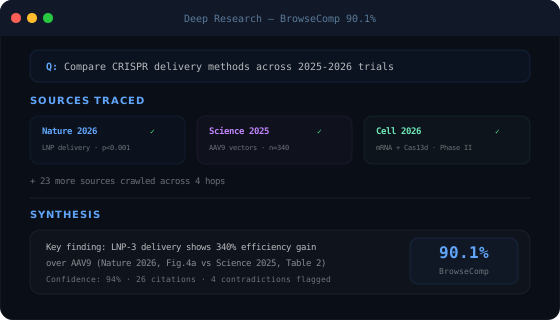
90.1% on BrowseComp — multi-hop queries across dozens of sources. Tops Gemini 3.1 Pro (85.9%) and Claude Opus 4.7 (79.3%). Autonomous evidence chains, cited conclusions.
What Makes GPT-5.5 Pro Different
Ground-Up Rebuild
GPT-5.5 Pro isn’t GPT-5.4 with extra layers. It’s the first fully retrained base model since GPT-4.5 — a complete architectural overhaul codenamed “Spud.” Every capability improvement builds on a stronger foundation, not patches on existing limitations. This is why the benchmark leaps are discontinuous: you’re not comparing versions, you’re comparing generations.
Per-Token Speed Parity
More capable doesn’t have to mean slower. GPT-5.5 Pro was co-designed with NVIDIA GB200 and GB300 hardware to achieve 20%+ token generation speed over GPT-5.4 while delivering greater capability. Production pipelines get a faster model and a smarter one simultaneously — a combination that has never held before in frontier model development.
72% Fewer Output Tokens
Despite a higher per-token list price ($30/M output), GPT-5.5 Pro generates approximately 72% fewer output tokens than Claude Opus 4.8 to accomplish equivalent coding tasks. The model communicates precisely and acts efficiently, meaning real-world cost for agentic coding pipelines runs at roughly half the Claude equivalent. Better benchmarks at lower actual spend.
NVIDIA Hardware Co-Design
GPT-5.5 Pro was not trained in isolation and deployed on commodity hardware. OpenAI and NVIDIA co-designed the model’s architecture alongside the GB200/GB300 NVL72 rack, allowing kernel-level optimizations that are invisible to models trained separately. The result is inference efficiency that compounds the cost advantage of shorter output sequences.
GPT-5.5 Pro vs The Competition
Independent benchmark results — all models available on Yesmind.
| Features |  GPT-5.5 Pro OpenAI |  Claude Opus 4.8 Anthropic |  Gemini 3.5 Flash Google |  DeepSeek V4 Pro DeepSeek |
|---|---|---|---|---|
| Terminal-Bench 2.0 | 82.7% | ~70% | 68.5% | TBD |
| ARC-AGI-2 | 85.0% | 75.8% | 77.1% | TBD |
| FrontierMath T1–3 | 51.7% | 43.8% | 36.9% | TBD |
| BrowseComp | 90.1% | 79.3% | 85.9% | TBD |
| OSWorld (Computer Use) | 78.7% | 78.0% | TBD | TBD |
| Context Window | 1M tokens | 200K+ tokens | 1M+ tokens | 1M tokens |
| MRCR v2 (512K–1M) | 74% | 32.2% | TBD | TBD |
| Output Price | $30/M tokens | $25/M tokens | $3.50/M tokens | $0.44/M tokens |
| Agentic Coding | ||||
| Computer Use | ||||
| Natively Omnimodal |
Benchmark Performance
GPT-5.5 Pro across the key evaluations that matter for real workloads
What People Build with GPT-5.5 Pro
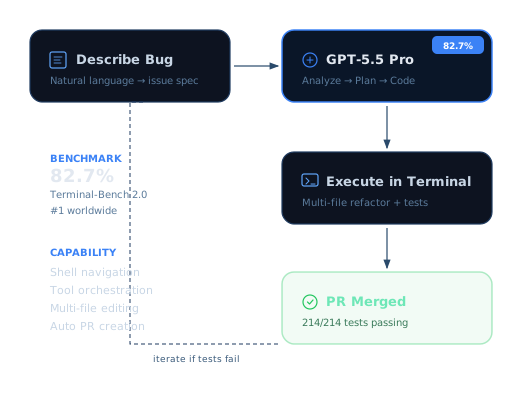
Coding Agents
Autonomous software engineering at scale. GPT-5.5 Pro navigates codebases, writes and tests code, resolves issues across multiple files, and submits working pull requests without hand-holding. The 82.7% Terminal-Bench score reflects what this looks like in production.
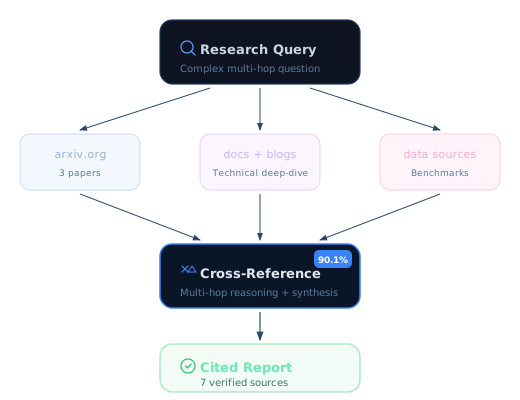
Research Workflows
Deep multi-source research that used to take a team of analysts. GPT-5.5 Pro’s 90.1% BrowseComp score means it can chase down obscure facts, synthesize conflicting sources, and return a cited summary — the kind of research output that previously required hours.
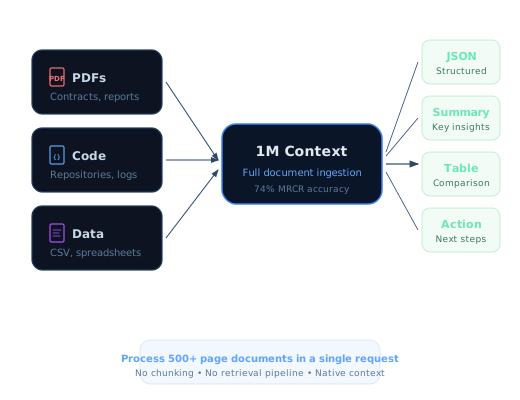
Document Processing
Feed GPT-5.5 Pro an entire legal contract suite, financial audit package, or technical specification library. With 1M tokens of context and 74% MRCR v2 retrieval accuracy, nothing slips through the cracks. Extract, compare, summarize, and flag — across documents that used to require specialized teams.
Desktop Automation
GPT-5.5 Pro’s 78.7% OSWorld score translates to real desktop task execution: navigating complex UIs, filling forms across applications, coordinating multi-app workflows, and completing tasks that previously required a human at the keyboard. Computer use that actually works in production.
How GPT-5.5 Pro Works
From a single prompt to autonomous multi-step execution

You Define the Goal
Describe what you want accomplished — not how to do it. GPT-5.5 Pro accepts natural language, code, images, documents, and audio as input. You set the objective; the model figures out the approach. The more context you provide, the more precisely it can plan.
The Model Plans & Reasons
GPT-5.5 Pro decomposes the goal into a sequence of steps, identifies what tools and information are needed, and builds an execution plan before acting. This internal reasoning step — scaled dramatically in the Thinking variant — is what separates autonomous execution from reactive response generation.
Autonomous Execution
The model executes the plan: calling tools, browsing the web, writing and running code, operating applications, or coordinating multi-step workflows. Each intermediate result is evaluated before the next step proceeds. You receive a complete, verified outcome — not a half-finished draft.
What Builders Say About GPT-5.5 Pro
A Top-End Senior Engineer
GPT-5.5 scored 62.5 on Every's Senior Engineer Benchmark — nearly double Opus 4.7's 33.5. It rewrites messy production codebases the way a senior engineer would, with cleaner structure and smoother logical progression.
It’s rare for a model to feel easier and stronger at the same time. GPT-5.5 is fast enough to use constantly, personable enough to collaborate with, and assertive enough to carry a plan through serious engineering work.
Code Review That Catches What Humans Miss
Ramp's AI DevEx team integrated Codex with GPT-5.5 into their code review flow. Engineers now request it by name for its thoroughness and ability to reason deeply against the codebase.
Codex code review catches things that I miss and that other engineers miss and that other AI code reviewers definitely miss.
Smarter and More Efficient Than Opus
Developers on r/ClaudeCode compared GPT-5.5 directly against Opus 4.7 for software design. The consensus: GPT-5.5 produces higher quality code with fewer tokens and offers substantially higher usage limits.
It is smarter than Opus and more efficient. GPT reviewed my codebase which was done by Opus 4.6 and 4.7 and it found so many bugs. The code quality is great and the speed is so much faster.
Token Efficiency: The Hidden Cost Advantage
At $30 per million output tokens, GPT-5.5 Pro’s list price sits above Claude Opus 4.8 at $25/M. On paper, that’s 20% more expensive. In practice, the opposite is true for the workloads that matter most.
<strong>GPT-5.5 Pro generates approximately 72% fewer output tokens than Claude Opus 4.8</strong> to accomplish the same coding tasks. It writes tighter code, eliminates verbose commentary, and reaches conclusions without preamble. That efficiency advantage inverts the per-token price comparison: the effective cost per completed task runs at roughly half the Claude equivalent for engineering pipelines.
The efficiency gain compounds with the 20%+ token generation speed improvement over GPT-5.4. Faster inference means shorter wall-clock time per request, which directly reduces the cost of time-sensitive agentic workflows where latency affects throughput. Teams running thousands of daily API calls find that the real bill looks nothing like the sticker math.
<strong>The practical implication:</strong> route your highest-volume agentic coding work through GPT-5.5 Pro. The benchmark lead pays for itself before the first invoice.