4× Faster. Same Intelligence.
Gemini 3.5 Flash — the fastest frontier model. $0.15/M input, $0.60/M output. Thinking on demand. On Yesmind.
What is Gemini 3.5 Flash?
Gemini 3.5 Flash is Google’s <span class="hl-pill">fastest frontier AI model</span>, released May 19, 2026 at Google I/O. At roughly <span class="hl-pill">280 output tokens per second</span> it runs approximately 4× faster than GPT-5.5 and Claude Opus 4.8 — while matching or exceeding them on agentic coding, long-context retrieval, and multimodal benchmarks. It is generally available today as <code>gemini-3.5-flash</code> with no preview suffix and no waitlist.
The model’s core thesis is that speed and intelligence are no longer a trade-off. <span class="hl-pill">SWE-Bench 81.0%</span> and <span class="hl-pill">Terminal-Bench 76.2%</span> both exceed Google’s own previous Pro-tier model. On the MRCR v2 long-context retrieval benchmark, Gemini 3.5 Flash scores 77.3% at 128k tokens — compared to Claude Opus 4.8’s 46.9% and GPT-5.5’s 41.4%. This is not a trimmed-down model for low-cost tasks; it is a full <span class="hl-pill">frontier-class intelligence</span> engine built for production-grade agentic workloads.
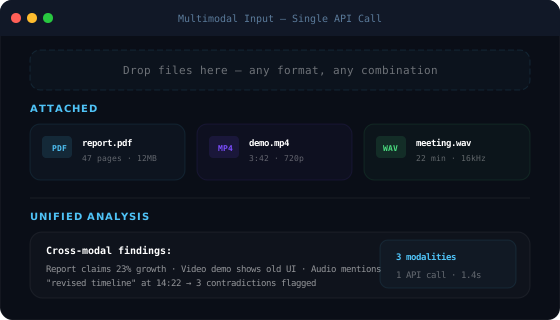
<span class="hl-pill">True native multimodality</span> sets Gemini 3.5 Flash apart from every competitor: text, image, audio, video, and PDF all process in a single API call, with no separate model routing or preprocessing pipeline. Combined with <span class="hl-pill">Thinking Levels</span> (Minimal through High) for granular cost-quality control, and deep integration into Google’s Antigravity 2.0 agentic infrastructure, Gemini 3.5 Flash is the model to reach for when you need frontier results on a production budget.
4× Speed Advantage
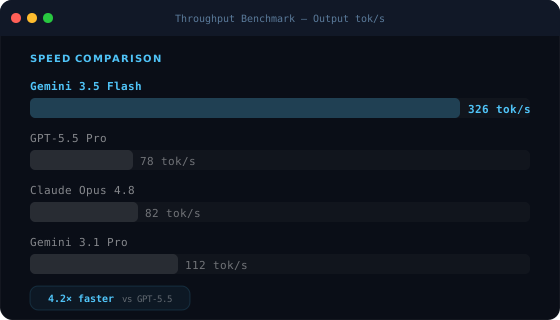
~326 tok/s output — 4× faster than GPT-5.5 Pro (78 tok/s) and Claude Opus 4.8 (82 tok/s). For agentic pipelines processing millions of tokens daily, this gap translates directly into cost and latency savings.
True Native Multimodality
Text, images, audio, video, PDFs — one model call, no routing, no preprocessing. 84% MMMU-Pro — highest multimodal score recorded. Five modalities natively, not as add-ons.
1M Token Context with Best Retrieval
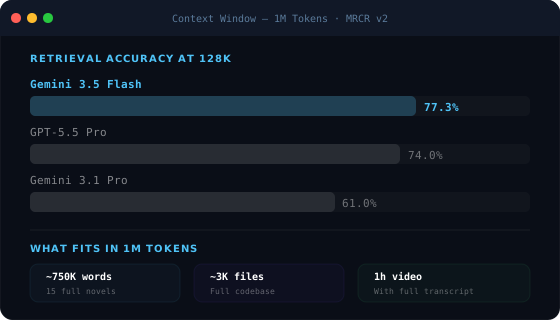
1M tokens with 77.3% MRCR v2 retrieval at 128K — vs Claude Opus 46.9% and GPT-5.5 41.4%. It doesn't just accept long contexts — it accurately retrieves from them.
Thinking Levels
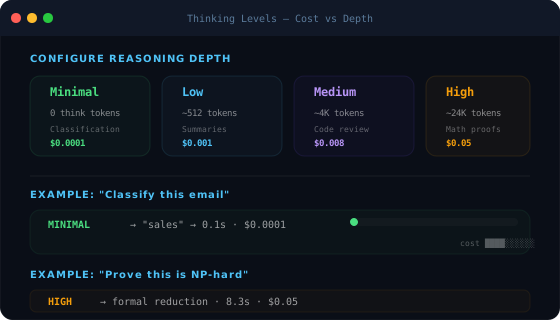
Four modes — Minimal, Low, Medium, High — tune cost and depth per request. Minimal: $0.0001 for classification. High: full reasoning for math proofs. One endpoint, four profiles, zero infra complexity.
Google Ecosystem Integration
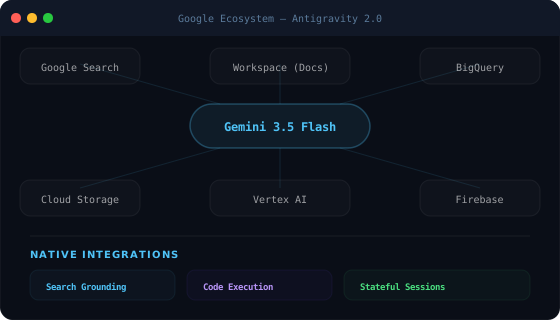
Antigravity 2.0: stateful sandboxes, multi-agent parallelism, MCP tools — built-in. Native Search grounding replaces RAG. Direct integration with Workspace, BigQuery, Vertex AI, Firebase.
Gemini 3.5 Flash vs Top Competitors
Independent benchmark data — see where each model wins and where it trades off.
| Features |  Gemini 3.5 Flash Google |  GPT-5.5 OpenAI |  Claude Opus 4.8 Anthropic |  DeepSeek V4 Pro DeepSeek |
|---|---|---|---|---|
| Output Speed (tok/s) | ~280 | ~70 | ~60 | ~80 |
| SWE-Bench | 81.0% | ~80% | 80.6% | 80.6% |
| Terminal-Bench 2.1 | 76.2% | 82.7% | 69.4% | 67.9% |
| MRCR v2 128k | 77.3% | 41.4% | 46.9% | TBD |
| MMMU-Pro (Multimodal) | 84% | TBD | TBD | TBD |
| Context Window | 1M tokens | 1M tokens | 200K+ | 1M tokens |
| Input Price per 1M | $1.50 | $5.00 | $15.00 | $0.435 |
| Output Price per 1M | $9.00 | $30.00 | $25.00 | $0.87 |
| Native Modalities | Text+Image+Audio+Video+PDF | Text+Image+Audio+Video | Text+Image | Text only |
| Thinking / Reasoning Modes | 4 levels (Minimal–High) | |||
| Agentic Infrastructure | Antigravity 2.0 (native) | OpenAI Responses API | Claude Code | Limited |
| Context Caching Discount | 90% ($0.15/M) | 50% | 90% | 75% |
Benchmark Performance
Gemini 3.5 Flash on independent third-party evaluations — agentic, coding, multimodal, and retrieval
Who Uses Gemini 3.5 Flash — and How
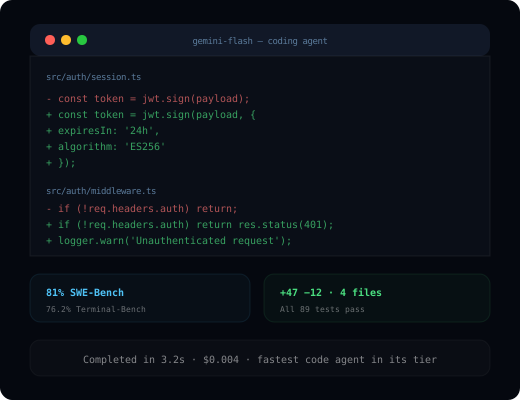
Agentic Coding
81% SWE-Bench, 76.2% Terminal-Bench. Antigravity 2.0 stateful sandboxes + multi-agent parallelism for multi-repo workflows. MCP tool protocols for tests, commits, deployments — autonomously.
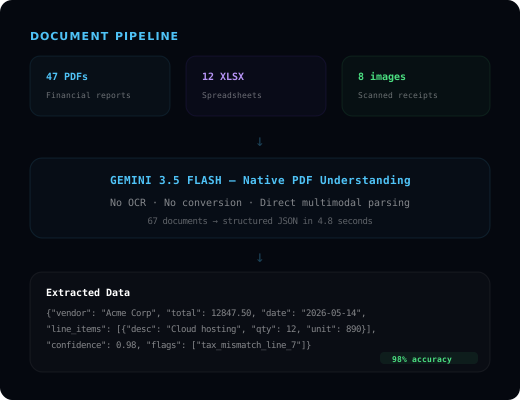
Document Processing
Native PDF understanding — no OCR, no conversion. Upload financial statements, contracts, or research papers and get structured JSON in one call. 1M context + 77.3% retrieval accuracy.
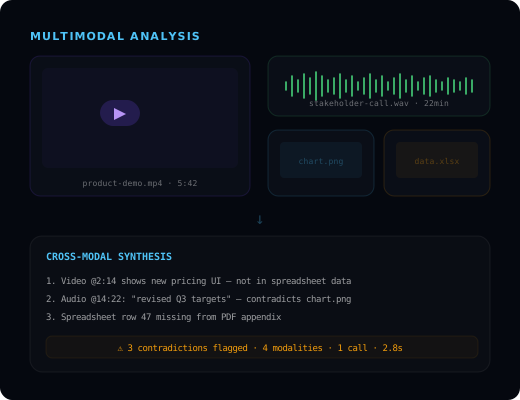
Multimodal Analysis
Video + audio + images + text in one API call. Analyze product demos, transcribe meetings, cross-reference charts with spreadsheets. 84% MMMU-Pro — highest multimodal score recorded.
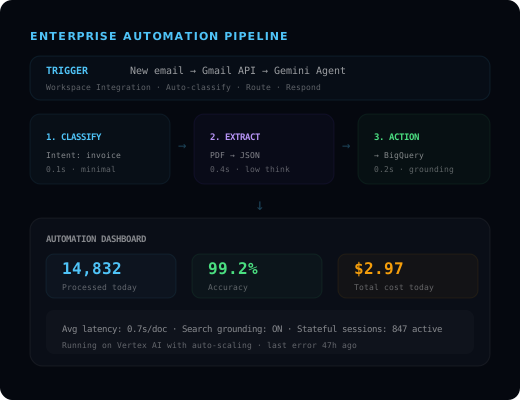
Enterprise Automation
Google Workspace, Search grounding, BigQuery, Vertex AI — all native. 90% context caching discount. Thinking Levels match compute cost to task complexity. Powers AI Mode for 1B+ users.
How It Works
Any input modality, instant results, Google-scale infrastructure

Send Any Modality
Pass text, images, audio, video, or PDF documents — individually or combined — in a single API request. No preprocessing, no separate model routing, no conversion pipeline. The model accepts raw files alongside your prompt and processes everything natively.
Flash Processing
Gemini 3.5 Flash executes at ~280 output tokens per second through Google’s production TPU infrastructure. Select your Thinking Level (Minimal through High) to tune the reasoning budget for your task. Context caching reduces cost by 90% for repeated document or system-prompt segments.
Instant Structured Response
Receive text, structured JSON, code, or function call outputs in real time via streaming. For agentic pipelines on Antigravity 2.0, the model can invoke tools, spawn sub-agents, and persist state across multi-step tasks — all within the same session.
What Makes Gemini 3.5 Flash Different
4× Faster Than Frontier Rivals
~280 output tokens per second puts Gemini 3.5 Flash in a category of its own at the frontier intelligence tier. GPT-5.5 delivers ~70 tok/s; Claude Opus 4.8 ~60 tok/s. For agentic systems processing millions of tokens per day, the throughput gap is the difference between economically viable and not. This is the model that makes real-time AI at frontier quality possible.
Native Five-Modality Input
Text, image, audio, video, and PDF — all processed natively in a single model call. No external OCR pipeline for PDFs. No separate audio transcription step. No image-to-text preprocessing. Competitors handle one or two modalities natively; Gemini 3.5 Flash handles all five. MMMU-Pro 84% is the highest recorded multimodal benchmark score.
77.3% MRCR Long-Context Retrieval
Having a 1M token context window is one thing. Actually retrieving the right information from it is another. MRCR v2 at 128k: Gemini 3.5 Flash 77.3% vs Claude Opus 4.8 46.9% vs GPT-5.5 41.4%. A 30-point accuracy lead that matters for legal, financial, and research document workflows where missing a single clause has real consequences.
90% Context Caching Discount
Repeated context — system prompts, reference documents, conversation history — costs $0.15/M tokens cached instead of the standard $1.50/M. For agentic workflows that reference the same codebase, policy document, or knowledge base across thousands of requests, caching alone cuts total inference cost by 30–50%. The economics of long-context AI change fundamentally at this discount rate.